
ISO 9001:2026 Revolution: Redefining Quality for a New Business Era
ISO 9001:2026 marks a transformative shift in how organizations approach quality management. Designed to reflect modern challenges such as digital disruption, environmental concerns, and complex supply chains, this updated standard goes beyond traditional compliance. It equips businesses with the tools needed to remain resilient, competitive, and future-ready in a rapidly evolving global market.
For organizations worldwide, including those operating in Australia, the revision presents an opportunity to strengthen systems, improve operational performance, and align with global best practices.
Why This Update Matters More Than Ever?
The ISO 9001:2015 version introduced essential concepts like risk-based thinking and process-driven management. While these principles remain relevant, the business environment has changed significantly over the past decade.
Organizations now face increasing pressure from technological advancements, climate-related risks, and global uncertainties. ISO 9001:2026 addresses these challenges by expanding the scope of quality management systems (QMS), ensuring they are better equipped to handle modern risks and opportunities.
Rather than simply maintaining quality, businesses are now encouraged to anticipate change, adapt quickly, and continuously improve.
The Key Shifts Shaping ISO 9001:2026
Climate Awareness Moves to the Forefront
Organizations must evaluate whether climate change has an impact on their operations. If identified as relevant, climate-related risks must be incorporated into planning, risk assessments, and improvement processes.
This approach ensures that sustainability becomes an integral part of quality management rather than a separate initiative handled in isolation.
Digital Transformation Becomes Essential
With the increasing reliance on automation and artificial intelligence, the updated standard emphasizes the need for proper governance of digital tools. Organizations must ensure that automated processes are accurate, reliable, and transparent.
In addition, building digital competency among employees is crucial to ensure that technology enhances quality outcomes rather than creating new risks.
Stronger Control over Supply Chains
ISO 9001:2026 introduces enhanced requirements for managing suppliers and external providers. Organizations are expected to identify critical supply chain dependencies, monitor supplier performance, and develop contingency plans.
Key focus areas include:
- Identifying high-risk suppliers and dependencies
- Establishing performance monitoring systems
- Creating backup sourcing strategies
- Improving communication across the supply chain
This proactive approach strengthens resilience and minimizes disruptions, ensuring consistent delivery of products and services.
Knowledge Management as a Strategic Priority
The revised standard recognizes knowledge as a valuable organizational asset. Businesses must implement systems to capture, retain, and transfer critical knowledge effectively.
This includes documenting processes, conducting training programs, and ensuring that expertise is preserved even when employees leave the organization.
Creating a Culture of Shared Responsibility
Leadership plays a vital role in fostering a culture where quality is everyone’s responsibility. Employee engagement, well-being, and competency development are now key elements of a successful QMS.
Organizations that build a strong quality culture often achieve better performance and sustained growth.
Greater Flexibility with Outcome-Based Focus
Unlike previous versions, ISO 9001:2026 focuses more on achieving results rather than following rigid procedures. Organizations have the flexibility to design processes that suit their operations while meeting the required outcomes.
This makes the standard more adaptable and scalable across different industries and business sizes.
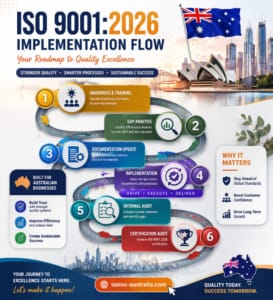
How to Approach the Transition Effectively?
For most organizations, the core structure of ISO 9001:2015—such as the process approach and PDCA (Plan-Do-Check-Act) cycle—remains unchanged. The key difference lies in expanding the scope of the QMS to address new requirements.
To ensure a smooth transition, organizations should:
- Conduct a detailed gap analysis
- Prioritize high-impact areas such as climate and digital risks
- Train employees and internal auditors
- Implement changes in phases to avoid disruptions
- Continuously monitor and improve processes
Organizations in Australia and other regions are already taking proactive steps to align with the updated standard, recognizing the long-term benefits of early adoption.
Common Mistakes to Avoid During Transition
One of the most common mistakes organizations make is treating the transition as a documentation exercise. Simply updating policies without implementing actual changes can result in non-compliance during audits.
Another frequent challenge is delaying the integration of climate and digital requirements. These aspects often require collaboration across multiple departments and cannot be addressed at the last minute.
Organizations also tend to underestimate the importance of knowledge management. Without proper systems in place, critical expertise may be lost, affecting both operational efficiency and compliance.
By addressing these areas early, businesses can ensure a smoother and more effective transition.
Business Benefits beyond Certification
While certification is an important milestone, the true value of ISO 9001:2026 lies in the improvements it brings to the organization.
Businesses that implement the standard effectively often experience stronger supplier relationships, reduced operational risks, and improved efficiency. They are also better equipped to handle unexpected disruptions and adapt to changing market conditions.
The emphasis on employee involvement and knowledge sharing leads to higher engagement and productivity. When quality becomes a shared responsibility, organizations achieve better results across all functions.
From a customer perspective, ISO 9001:2026 certification demonstrates a commitment to modern, reliable, and globally recognized quality practices, enhancing trust and credibility.
Final Thoughts: Turning Compliance into Competitive Advantage
ISO 9001:2026 is more than just an update—it reflects the realities of modern business. By integrating climate awareness, digital transformation, supply chain resilience, and human factors into quality management, it creates a comprehensive framework for success.
Organizations that embrace these changes early can transform compliance into a strategic advantage. Instead of viewing the transition as a requirement, it should be seen as an opportunity to build a stronger, more adaptable, and future-ready organization.

