
ISO 14001:2026 and the New Environmental Reality – What It Means for Modern Businesses?
Australia has long operated under some of the world’s most stringent environmental expectations. From climate-related risks to strict regulatory oversight, businesses are already under pressure to demonstrate responsible environmental practices.
But ISO 14001:2026 introduces something different.
It doesn’t just raise expectations—it changes how environmental performance is defined, measured, and managed. The focus is no longer on maintaining a system that works “on paper.” Instead, organizations must prove that their environmental management system is active, responsive, and continuously improving in real-world conditions.
For Australian organizations, this means moving toward a model where environmental management becomes part of everyday operations—not something reviewed occasionally, but something that is constantly visible and controlled.
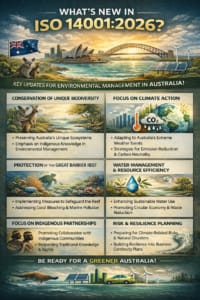
A Shift from Control to Continuous Environmental Awareness
One of the most fundamental changes in ISO 14001:2026 is the expectation that organizations maintain ongoing awareness of their environmental impact.
- Environmental data becomes a continuous flow, not a periodic snapshot
Instead of reviewing environmental performance at fixed intervals, organizations must build systems that provide constant insights into emissions, waste, and resource use. This creates a more responsive and adaptable management approach. - Operational decisions are increasingly guided by live environmental signals
Teams are expected to respond to real-time conditions rather than relying on historical reports. This leads to quicker adjustments and better alignment between operations and environmental goals. - Visibility replaces assumption in environmental performance
Organizations can no longer depend on assumptions about their impact. Continuous tracking ensures that performance is transparent, measurable, and verifiable at any point in time.
Environmental Responsibility Moves Closer to Core Business Decisions
ISO 14001:2026 brings environmental management directly into the center of business strategy, particularly relevant in Australia where sustainability is closely tied to corporate reputation and regulatory compliance.
- Sustainability becomes part of everyday decision-making
Environmental considerations are expected to influence operational, financial, and strategic decisions. This ensures that sustainability is embedded across all levels of the organization. - Executive leadership is expected to demonstrate active ownership
Leaders are no longer distant approvers of environmental policies. They are required to show clear involvement in driving outcomes and improving performance. - Environmental performance begins to influence business growth
Companies that demonstrate strong environmental control are more likely to gain trust from stakeholders, secure partnerships, and expand into new markets.
Building a System That Thinks Ahead, Not Just Reacts
ISO 14001:2026 encourages organizations to move toward systems that are capable of anticipating challenges rather than simply responding to them.
- Data is used to identify patterns and future risks
Organizations are expected to analyze trends in environmental performance to predict potential issues. This reduces uncertainty and supports better planning. - Preventive action becomes more important than corrective action
The focus shifts toward avoiding problems altogether rather than fixing them after they occur. This improves efficiency and reduces operational disruptions. - Continuous improvement becomes a built-in function, not a separate activity
Systems are designed to evolve over time, learning from past performance and adapting to new conditions. This ensures long-term effectiveness and resilience.
Why This Matters in the Australian Context?
Australia’s environmental landscape is unique. Businesses operate under increasing scrutiny due to climate change impacts, resource management challenges, and strict environmental governance.
ISO 14001:2026 aligns closely with these realities by encouraging systems that are not only compliant but also adaptive and forward-looking.
Industries such as mining, construction, energy, and agriculture will particularly feel the impact of this shift. These sectors already face high environmental expectations, and the new standard provides a framework to manage those expectations more effectively.
At the same time, service-based and emerging industries are also expected to demonstrate stronger environmental accountability. Sustainability is no longer limited to high-impact sectors—it is becoming a universal expectation.
Preparing for the Transition: A Practical Perspective
Adapting to ISO 14001:2026 requires more than updating documents—it requires rethinking how environmental management is approached.
Organizations need to start by understanding how their current systems function in practice. Many will find that while processes exist, they lack real-time visibility and predictive capability.
The next step is to introduce tools and systems that provide continuous insight into environmental performance. These tools help organizations move from reactive management to proactive control.
Equally important is the role of people. Employees at all levels must understand how environmental data is used and how their actions contribute to overall performance. Building this awareness ensures that the system functions effectively.
Finally, organizations must look beyond their internal operations. Engaging suppliers, partners, and stakeholders ensures that environmental responsibility is shared and consistently maintained across the value chain.
The Growing Influence of Intelligent Systems
While ISO 14001:2026 does not mandate specific technologies, it strongly aligns with the capabilities offered by digital and AI-driven systems.
These technologies allow organizations to process large volumes of environmental data quickly, identify patterns, and generate actionable insights. This makes environmental management more precise and less dependent on manual processes.
More importantly, intelligent systems enable prediction. By analyzing trends, organizations can anticipate risks and take preventive action. This aligns perfectly with the standard’s emphasis on proactive management.
Over time, these systems also support continuous improvement by learning from data and optimizing processes. This creates a more resilient and adaptable environmental management system.
Final Insight
ISO 14001:2026 is not about adding more requirements—it is about raising expectations. It asks organizations to move beyond surface-level compliance and build systems that truly reflect their environmental performance.
For Australian businesses, this is an opportunity to lead rather than follow. Those who embrace the change will not only meet regulatory expectations but also set new standards for sustainability and operational excellence.
The future of environmental management is not static—it is active, intelligent, and constantly evolving. The sooner organizations align with this reality, the stronger their position will be in the years ahead.

