
ISO 14001 Certification
About ISO 14001 Certification in Australia
ISO 14001 is a well-known international standard that takes a high-level approach to improve an organization’s environmental performance and successfully reducing its effects.
ISO 14001 certification corresponds to ISO 9001. As a result, obtaining ISO 14001 certification in Australia might assist you in integrating your other management systems in order to successfully carry out operations.
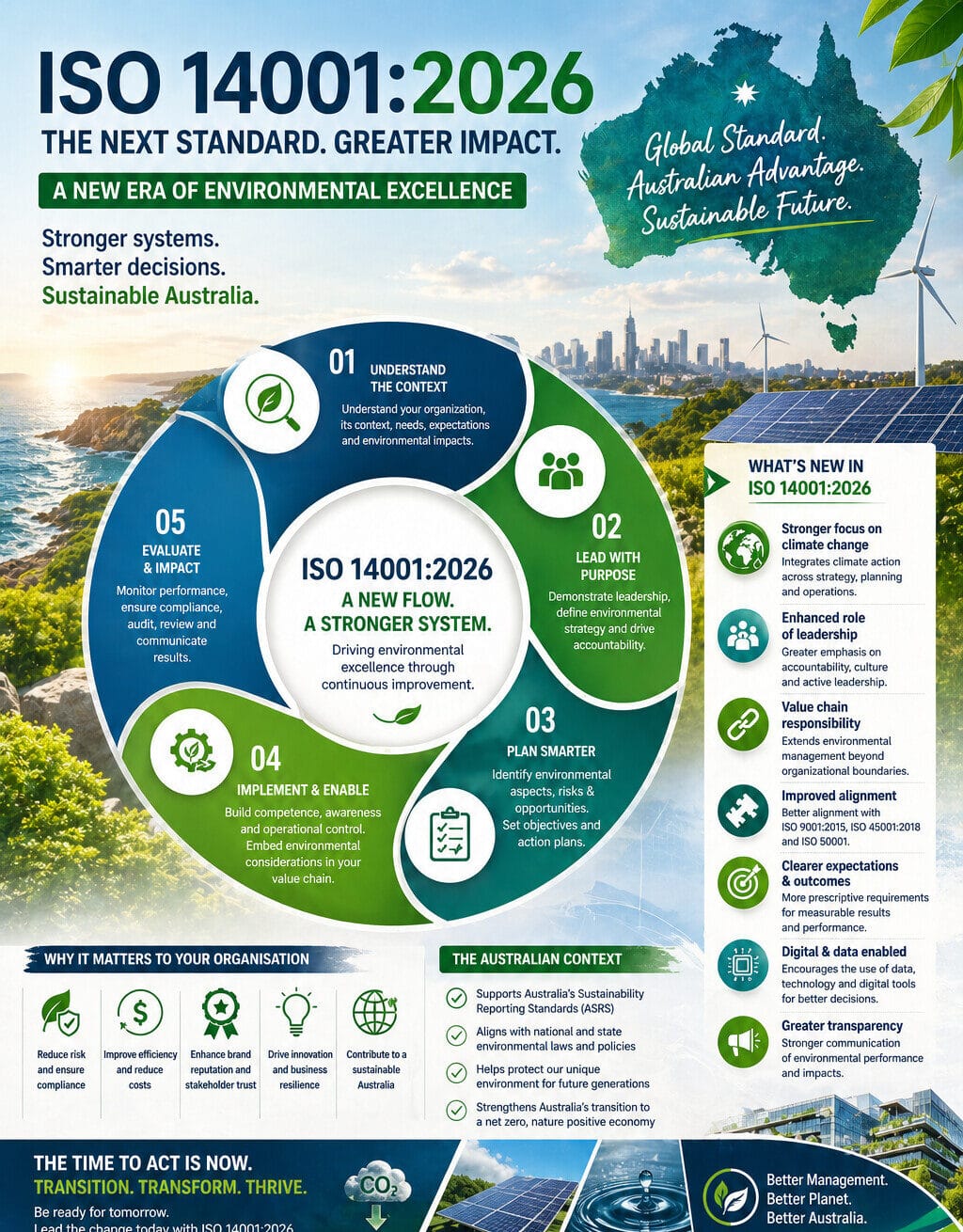
Now that ISO 14001:2026 has been officially published on April 15, 2026, organizations in Australia have a defined new benchmark to work towards for environmental management excellence.
Importance of ISO 14001 Certification in Australia
Obtaining ISO 14001 certification enables a business to effectively assess, monitor, measure, and eliminate negative environmental consequences.
ISO 14001 enables companies to comply with applicable laws, rules, and other environmental obligations while also improving their management systems’ accountability.
Furthermore, ISO 14001 in Australia enables firms to successfully fulfill their goals, environmental policies, and objectives in order to develop their businesses.
What ISO 14001:2026 Means for Australian Businesses?
The upcoming ISO 14001:2026 revision is not just a minor update — it signals a shift in how organizations are expected to manage and report on environmental performance. Australian businesses that are already certified or planning certification should take note of the following anticipated changes:
- Climate change is expected to be formally embedded as an environmental aspect, requiring organizations to assess climate-related risks and opportunities within their EMS
- Life cycle thinking requirements are set to be strengthened, extending accountability beyond the facility to supply chains and end-of-life product impacts
- Alignment with other ISO management systems through the Annex SL framework is expected to be reinforced, making integrated audits easier
- Biodiversity and ecosystem protection are likely to feature more prominently, particularly relevant to Australian industries such as agriculture, mining, and forestry
- Enhanced stakeholder communication and external environmental reporting obligations are anticipated to become more explicit
- Organizations will need to demonstrate a stronger link between their environmental objectives and measurable performance outcomes
Starting your ISO 14001:2026 transition planning now gives your organization a significant competitive advantage when the standard is officially published.
Organizations that Can Apply for ISO 14001 Certification in Australia
The ISO 14001 standard should be followed by all businesses that wish to offer a safe working environment for their employees.
ISO 14001 certification in Australia may be obtained by any business, regardless of size or style — from a single office building to a worldwide corporation.
ISO 14001 certification may help any industry, including manufacturing and processing, agriculture, forestry, and fisheries management.
Procedure for ISO 14001 Certification in Australia
A firm that gets ISO 14001 certification in Australia is expected to have a documented environmental management system with established environmental policies, procedures, responsibility assignments, roles, and duties.
ISO 14001 certification in Australia covers the majority of an organization’s environmental management system operations. ISO audits are also conducted by certification authorities to ensure that firms comply with ISO regulations.
Designing and implementing an EMS that follows ISO best practices, getting it up and running, and having an ISO-approved auditor perform a complete audit of the system are all part of the ISO 14001 certification process.
This audit may necessitate a lot of paperwork, and the auditor may make suggestions that must be followed in order to get ISO 14001 certification in Australia.
Once you successfully achieve ISO certification, you can check the status of your certificate by visiting our ISO 14001 certification Search Page!
How to Prepare Your EMS for the ISO 14001:2026 Transition?
Whether you are newly certified or have held ISO 14001 certification in Australia for years, preparing early for ISO 14001:2026 is a smart business decision. A structured transition approach reduces disruption and ensures audit-readiness from day one.
Key steps to prepare your EMS for ISO 14001:2026:
- Conduct a gap analysis comparing your current ISO 14001:2015 EMS against the anticipated ISO 14001:2026 requirements
- Review your environmental aspects register to incorporate climate-related risks and biodiversity considerations
- Engage your supply chain early to address expanded life cycle thinking obligations
- Update your internal audit program to include emerging ISO 14001:2026 clauses and performance indicators
- Train your internal auditors and EMS team on the key changes expected under ISO 14001:2026
- Document a formal transition plan with clear milestones, responsibilities, and target completion dates
IAS can support your organization through every stage of this transition — from gap analysis to final certification audit.
Online Audits for ISO 14001 Certification in Australia
To obtain ISO 14001 certification in Australia, organizations must undergo successful external audits.
IAS now conducts ISO 14001 certification audits using an online web testing platform. After the audit is successfully conducted, IAS offers a certificate verifying that your business has earned ISO 14001 certification — based on online test scenarios covering your system documentation, policies, and other connected procedures.
The online audits conducted by IAS provide a convenient, inexpensive, and less time-consuming way to achieve ISO 14001 certification in Australia.
Advantages of ISO 14001 Certification in Australia
The following are just some of the many benefits of achieving ISO 14001 certification in Australia:
- Shows a commitment to all existing and future rules and regulations
- Increased safety of employees within the organization
- Enhances the corporate image of the company
- A firm may obtain a competitive edge and save money by maximizing the use of environmental resources
- Increases customer satisfaction and loyalty
- Increases the confidence of stakeholders in the company
- Provides a positive image for the firm
Why Choose IAS for ISO 14001 Certification in Australia?
Despite the fact that the International Organization for Standardization (ISO) develops and publishes ISO 14001 standards, it does not provide ISO 14001 certification. As a result, companies rely on third-party certifying agencies like IAS to get ISO 14001 certification.
Integrated Assessment Services (IAS) is a worldwide recognized ISO 14001 certification body accredited by Universal Quality Accreditation Services (UQAS).
We provide ISO 14001 certification in Australia as well as other nations across the world. We have two decades of professional expertise in auditing and delivering ISO 14001 certification, having been founded in 2006.
We are independent auditing specialists and the most trusted ISO 14001 certification organization in guaranteeing that international management standards are met. We successfully assist our clients in implementing a management system that will help them grow and flourish.
For more information on ISO 14001 certification in Australia and ISO 14001 certification process, please contact us or check our ISO 14001 certification frequently asked questions page to learn more