
GMP Internal Auditor Training in Australia
GMP internal auditor training in Australia prepares quality, production and laboratory staff to audit their own manufacturing site against Good Manufacturing Practice requirements. The course covers scoping an audit, building a checklist worth using, gathering evidence that stands up to challenge, writing findings people can act on, and confirming later that the fix held.
Australian manufacturers in pharmaceuticals, complementary medicines, food, cosmetics and contract packing face the same commercial reality: customers ask for evidence, not assurances. A site that audits itself properly walks into external audits with no surprises, because it already knows what an auditor will find.
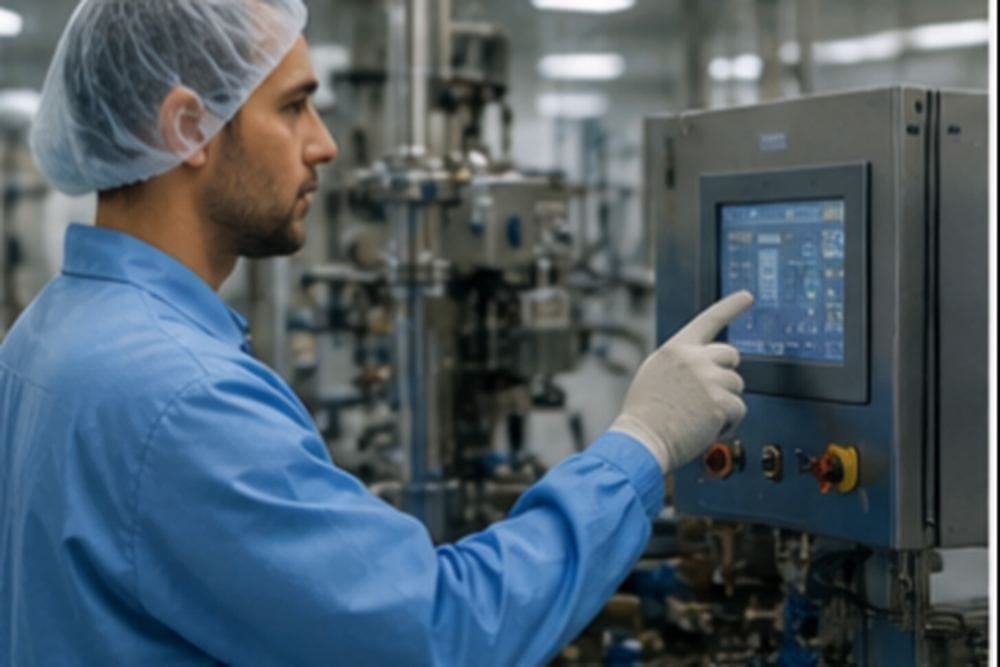
What GMP and cGMP Internal Auditor Training Covers
The training prepares staff to conduct first-party audits — audits of their own organisation — against Good Manufacturing Practice requirements and the company’s own documented system.
You will hear both GMP and cGMP used for this course. GMP is the general term. cGMP adds an explicit emphasis on staying current: procedures, training and records are expected to keep pace with how the plant actually operates, rather than being written once and shelved. For the auditor the method is identical. You compare a requirement against reality and record what you find.
Three things sit at the centre of the course. The first two are enough GMP knowledge to know what good looks like in each area, and a repeatable audit method. The third is the behavioural side: staying impartial, keeping findings factual, and disagreeing without damaging working relationships.
What the training does not do is certify your company. Internal auditor training builds individual competence; independent assessment of the site is a separate exercise, covered on the cGMP certification in Australia page. If your team needs broader manufacturing-quality grounding rather than audit technique specifically, GMP training in Australia is the better starting point.
Evidence Is the Whole Job
New auditors often think the skill is knowing the rules. It is not. Most people in a quality role already know the rules. The skill is proving what is actually happening, and proving it in a way nobody can wave away. That proof comes from three places, and a finding is only as strong as the number of them that agree.
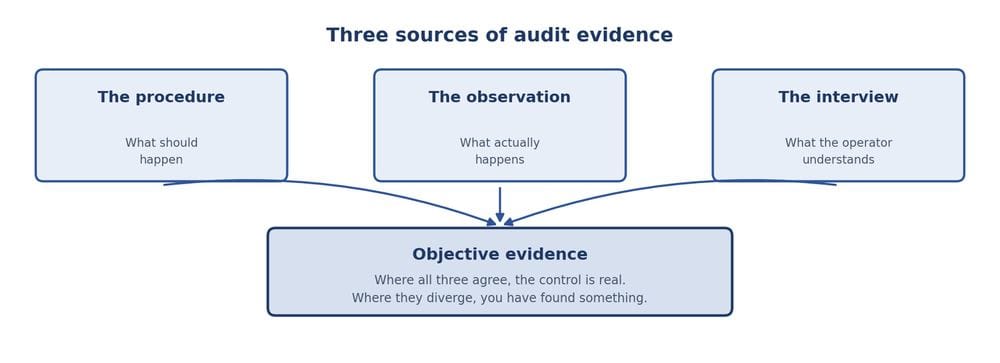
Read the procedure and you know what should happen. Watch the operation and you know what does happen. Ask the person doing it and you learn whether they understand why. Where all three line up, the system is working. Where they diverge, you have found something real.
A worked example
The SOP requires a second-person verification on every weighing step. The weighing sheets all carry two signatures. So far, so compliant. But watching the operation shows the verifier signs at the end of the shift for the whole batch, from memory. The records look perfect and the control does not exist. No amount of document review alone would have caught it.
What an Internal Auditor Does Day to Day
The work is unglamorous and largely practical. An auditor spends their time reading, watching, asking and writing.
- Reading means procedures, batch records, logbooks, calibration certificates, training matrices and previous audit reports.
- Watching means being on the floor during a real operation rather than a demonstration arranged for your benefit.
- Asking means short, open questions — “show me how you record a line clearance” beats “do you record line clearances?” every time.
- Writing means capturing what you saw with enough reference detail that someone reading it in six months still knows exactly what happened.
An auditor also decides how far to look. If one cleaning record is missing a signature, that is a slip. If four of the last ten are, that is a system problem, and the finding should say so. Knowing when to widen the sample is one of the judgements the training builds.
Grading What You Find
Not every gap deserves the same weight. Overstating findings makes auditors unpopular and gets them ignored; understating them lets real risk sit unaddressed. The training gives participants a consistent way to grade.
| Classification | What it means | Typical example |
|---|---|---|
| Major nonconformity | A control is absent, or has failed in a way that could affect product quality | No batch record exists for a released batch; a critical process step has never been validated |
| Minor nonconformity | A control exists but has lapsed in isolated instances | One calibration certificate expired last month on an in-use instrument |
| Observation | Conformant today, but trending toward a problem | Training records are current but requalification has no scheduled trigger |
| Opportunity for improvement | No requirement breached; a better way is available | Two logbooks record overlapping data and could be merged |
The wording matters as much as the grade. A finding should state the requirement, then the evidence, then the gap between them — in that order, without adjectives and without naming individuals.
Building a Checklist That Earns Its Place
Most weak audits trace back to a weak checklist. Generic prompts produce generic answers and nothing gets examined. The course spends real time on turning requirements into questions that force evidence into the open.
| Weak checklist question | Stronger version | Why it works |
|---|---|---|
| Is equipment calibrated? | Verify the calibration status of the three instruments in use on Line 1 today against the calibration schedule | Names a scope, a source and a comparison |
| Are staff trained? | For two operators on shift, confirm training records cover the specific SOPs they are performing today | Tests the link between the matrix and the actual task |
| Is documentation controlled? | Confirm the SOP version at the workstation matches the current version in the document register | Catches the most common documentation failure |
| Is CAPA effective? | For two CAPAs closed in the last quarter, identify what evidence was used to confirm effectiveness | Tests closure quality, not closure count |
How the Audit Runs
An internal audit follows the same shape whether it takes half a day or three.
Scope, criteria and preparation
Scope and criteria are fixed first: which process, which lines, which period of records, and what you are auditing against. Preparation follows — reading the relevant procedures, the previous report and any open corrective actions, then drafting the checklist. Skipping preparation is the single most common reason an audit produces nothing useful.
On the day
A brief opening meeting confirms scope and timing so the area is not caught off guard. The auditor then works through the plan, moving between records, observation and conversation, taking referenced notes as they go. Anything unclear gets followed up while you are still standing there, because reconstructing it later never works.
Findings, report and follow-up
Findings are drafted and classified before the closing meeting, not invented during it. The closing meeting is for presenting them plainly and correcting factual errors, not for negotiating grades. The report follows, and then the part that actually creates improvement: reviewing the root-cause analysis, checking that the proposed action addresses the cause, and going back later to verify it worked.
Who Benefits From GMP Internal Auditor Training
| Group | What they get from it |
|---|---|
| QA teams | A defensible audit programme and better CAPA closure discipline |
| Production supervisors | The ability to read a finding correctly and fix the cause rather than the symptom |
| QC and laboratory staff | Clarity on how test records, calibration and out-of-specification investigations are examined |
| Engineering and maintenance | Understanding of calibration status, equipment logs and change-control evidence |
| Warehouse and logistics | Coverage of receipt, quarantine, release and storage-condition records |
| Contract manufacturers | A method that also works for auditing their own suppliers |
| New quality hires | A structured introduction to how a GMP system is meant to hang together |
The course assumes no prior audit experience. People already working inside a GMP system move fastest, because every step maps onto something they recognise. Anyone new to manufacturing quality is better served starting with fundamentals before the audit technique will land, and a cGMP foundation course fills that gap. The same audit method underpins the wider ISO internal auditor training range, so auditors who later work to a different standard are not starting again.
Skills You Walk Away With
- Scoping an audit so it is finishable in the time available and still meaningful
- Writing checklist questions that name a source, a sample and a comparison
- Sampling records so the sample represents the period, not the top of the pile
- Interviewing without leading, and recognising a rehearsed answer
- Recording evidence with references — document numbers, batch numbers, dates, equipment IDs
- Grading findings consistently, so the same issue gets the same weight from any auditor
- Writing findings that survive challenge because they state fact, not opinion
- Testing whether a corrective action addressed the cause or just tidied the symptom
- Auditing colleagues without either going soft or going hostile
Why Australian Manufacturers Invest in It
The commercial case is straightforward. Sites with a working internal audit programme find external audits uneventful, because nothing turns up that the team had not already seen. Supplier questionnaires get answered from evidence rather than from memory. And the quality system stays alive between external visits instead of being resuscitated a fortnight before one.
There is an operational case too. Internal audits catch documentation drift early, which is where most quality problems begin. A batch record can quietly stop matching the process, a logbook may go three weeks without anyone initialling it, or a change made on the line may never be assessed. These are cheap to fix when found internally and expensive when found by a customer.
Manufacturers holding third-party certification usually run both together: the certificate provides external credibility, and the internal audit programme keeps the system honest in between. The broader argument for that combination is set out in navigating pharma quality with GMP certification.
Training and Certification Are Not Interchangeable
| GMP internal auditor training | cGMP certification | |
|---|---|---|
| Subject | An individual employee | The organisation and its site |
| Audit type | First-party, conducted internally | Third-party, conducted by an independent body |
| Result | Competent internal auditors, recorded in the training file | A certificate covering a defined scope |
| Ongoing | Audits run all year to the internal programme | Surveillance and recertification on a set cycle |
They support each other but they are not substitutes. Completing the training does not certify a company, and holding a certificate does not remove the requirement to audit yourself.
GMP Internal Auditor Training in Australia: Course Format and Delivery
How long the course runs depends on the number of participants and the route chosen, and the fees are set out in the same written quotation. Everyone who finishes receives a certificate of completion listing the syllabus and the date, for your training records. Report writing is part of the course: participants practise wording a finding that survives challenge, and reaching the root cause of a recurring problem without naming anyone.
Delivery options
The training is delivered in classroom, live virtual and self-paced online formats, and can be run in-house for a company’s own team. In-house delivery has a practical advantage: examples can be drawn from your own processes, and the group can draft checklists for areas they will actually audit. If scheduling around production is the constraint, online cGMP internal auditor training runs at each participant’s own pace, while virtual cGMP training keeps the live discussion without the travel. The full GMP internal auditor training outline sets out the same syllabus in detail.
Tell us where the site is, what you make and how many people you want trained, and IAS will recommend a format and a date. One boundary worth stating plainly: IAS trains auditors and certifies management systems. It does not license facilities or approve products — those decisions belong to regulators, and no training provider should suggest otherwise.
Frequently Asked Questions
Is GMP internal auditor training the same as cGMP internal auditor training?
In practice, yes. The audit method taught is identical. The difference is emphasis: cGMP stresses that procedures, training and records must stay current rather than being written once. Course titles vary between providers and markets, but participants learn the same skills — planning, checklists, evidence collection, findings, reporting and corrective-action follow-up.
How long does it take to become useful as an internal auditor?
The course gives you the method. Competence comes from doing two or three audits alongside someone experienced, which most companies arrange over a few months. Sites commonly pair a newly trained auditor with an established one for the first cycle, then let them lead a low-risk area before moving to production or laboratory audits.
Can I audit my own department?
No, and the training explains why. Auditor independence means you audit areas you do not work in or have responsibility for. This is why companies train a cross-functional group — QA can audit production, production can audit warehouse, and so on — rather than concentrating the capability in one team.
What evidence should an internal auditor actually record?
Anything that lets someone else verify the finding without repeating the audit: document numbers and revisions, batch and lot numbers, equipment IDs, dates, the specific records sampled, and what was observed and when. A statement without a reference is an opinion, and opinions do not survive the closing meeting.
How many internal audits should a site run each year?
There is no universal number. The audit programme is usually risk-based: high-impact areas such as production, documentation and quality control are audited more often than low-risk support functions, and any area with recent findings gets revisited sooner. The programme is reviewed annually and adjusted based on what previous audits found.
Is this suitable for food and cosmetics manufacturers, not just pharma?
Yes. Auditing is a method, and the method travels. A cosmetics manufacturer and a sterile injectables plant use the same planning, sampling and evidence discipline — they simply point it at different requirements. What shifts between sectors is where the risk sits, and therefore where an auditor spends their hours.
What happens if the area disagrees with a finding?
The closing meeting allows factual correction: if the auditor misread a record or missed a document, the finding is amended. What is not open to negotiation is the grade, once the facts are settled. The training covers how to hold that line professionally, which most new auditors find harder than the technical side.
What should an auditor do about something found outside the audit scope?
Record it and report it separately, but do not chase it during the audit. Scope exists so the planned areas actually get examined; abandoning it to follow an unrelated issue is how audits end without covering what they were called to cover. Significant safety or quality concerns are raised immediately with the area and the quality manager, then picked up properly in a later audit.