
ISO 14001:2026 Migration Internal Auditor Training
Build Internal Audit Confidence under the New Standard
Environmental compliance is no longer a back-office function – it is a boardroom priority across every industry in Australia.
With ISO 14001:2026 officially published on April 15, 2026, organizations are now required to restructure their internal audit programs to reflect the new standard’s mandatory requirements. According to ISO, the transition period following publication gives organizations a defined window to upgrade their systems — and internal auditors are the first line of defense in making that transition successful.
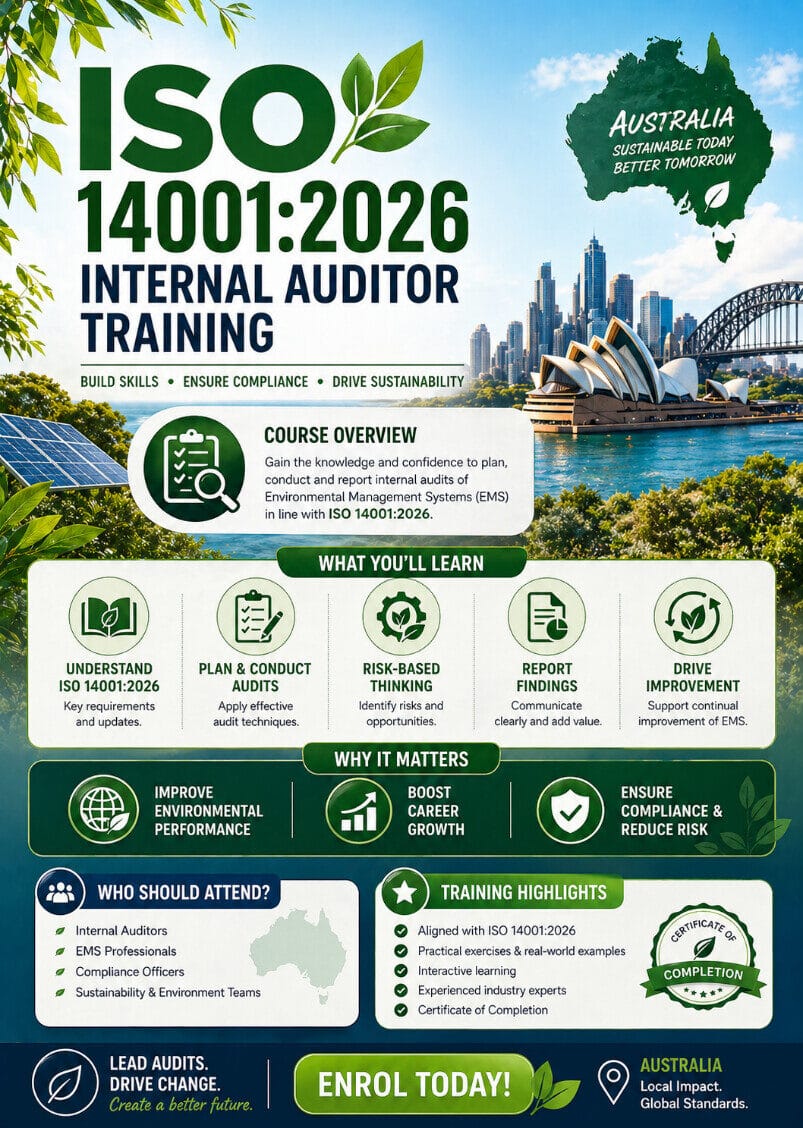
Our ISO 14001:2026 Migration Internal Auditor Training is designed specifically for professionals operating inside organizations — not external certification auditors, but the people responsible for keeping their own EMS audit-ready, compliant, and continuously improving under the newly published standard.
Why Internal Auditors Are Critical to the ISO 14001:2026 Transition?
External auditors assess your EMS from the outside. Internal auditors build it from within.
As ISO 14001:2026 introduces mandatory new requirements around climate change, biodiversity, and supply chain accountability, organizations that lack trained internal auditors will struggle to identify gaps, correct non-conformances, and demonstrate readiness before their next external certification audit.
The updated ISO 14001:2026 standard places stronger emphasis on:
- Climate change formally embedded as a mandatory environmental aspect within internal planning processes
- Lifecycle thinking requirements now extending internal audit scope to supply chain and end-of-life impacts
- Leadership accountability requiring internal auditors to assess top management’s active EMS involvement
- Risk-based environmental decision-making embedded across every clause of the internal audit program
- Biodiversity and ecosystem impacts now requiring formal assessment within the internal aspects register
- Direct ESG integration meaning internal auditors must connect EMS performance data to external reporting obligations
This means your internal audit program must evolve too. This ISO 14001:2026 migration training ensures your internal auditors are equipped, confident, and competent to meet every new requirement from day one.
ISO 14001:2015 vs ISO 14001:2026 — What Changes for Internal Auditors
Climate Change
Under ISO 14001:2015, climate change was an optional consideration that internal auditors rarely needed to formally assess. Under ISO 14001:2026, it is a mandatory environmental aspect — internal auditors must now verify that climate-related risks and opportunities are documented, assessed, and actively managed within the organization’s EMS planning processes.
Life Cycle Thinking
ISO 14001:2015 encouraged life cycle awareness but left its application largely discretionary. ISO 14001:2026 explicitly strengthens this requirement, meaning internal auditors must now audit beyond the facility fence — verifying that the organization has assessed environmental impacts across its supply chain and product end-of-life stages.
Biodiversity
Biodiversity was absent as a standalone requirement under ISO 14001:2015. ISO 14001:2026 formally includes it, requiring internal auditors in Australian organizations — particularly those in mining, agriculture, and construction — to assess and document ecosystem and biodiversity impacts as part of every internal EMS audit cycle.
ESG Alignment
The link between ISO 14001:2015 and ESG reporting was indirect and largely self-managed. ISO 14001:2026 directly integrates ESG alignment, meaning internal auditors must now gather evidence that the organization’s environmental performance data supports and aligns with its external ESG disclosure obligations to investors and regulators.
Stakeholder Reporting
ISO 14001:2015 set broad communication obligations without prescribing depth or transparency. ISO 14001:2026 enhances these requirements explicitly — internal auditors must now verify that stakeholder reporting processes are structured, consistent, and verifiable rather than ad hoc or reactive.
Supply Chain Accountability
Under ISO 14001:2015, internal audit scope was primarily limited to the organization’s own operational boundaries. ISO 14001:2026 extends accountability to end-of-life product impacts — internal auditors must now assess whether the organization has documented and managed environmental obligations that extend beyond its own four walls.
What This ISO 14001:2026 Internal Auditor Training Covers?
This is a 2-day practical training program built specifically around the internal auditor’s role within an organization transitioning to ISO 14001:2026.
Day 1 – Understanding ISO 14001:2026 and Internal Audit Foundations
Day 1 establishes a strong working knowledge of the new standard from an internal auditor’s perspective. Topics covered include key differences between ISO 14001:2015 and ISO 14001:2026, Annex SL harmonized structure and its relevance to integrated internal audit programs, context of the organization and updated EMS scope requirements, leadership roles and how internal auditors assess top management involvement, risk and opportunity management under the new standard, climate change as a formal environmental aspect, compliance obligations, documentation requirements, and operational control assessment.
Practical activities on Day 1 include building ISO 14001:2026 internal audit checklists, mapping environmental aspects against new standard requirements, and evaluating real-life internal audit scenarios drawn from Australian industry contexts including mining, construction, and manufacturing.
Day 2 – Internal Audit Practice and Assessment
Day 2 shifts entirely to hands-on internal audit simulation. Delegates practice opening meeting conduct, audit interview techniques, objective evidence gathering against ISO 14001:2026 clauses, identifying and classifying non-conformances, and writing clear corrective action requests.
The day concludes with a practical internal audit assessment. By the end of Day 2, every delegate will be ready to plan, conduct, and report a complete internal audit cycle aligned to ISO 14001:2026 within their own organization.
Who Should Attend This Course?
This ISO 14001:2026 Migration Internal Auditor Training is specifically designed for:
- Environmental coordinators and officers responsible for maintaining the organization’s EMS
- Internal auditors currently conducting audits under ISO 14001:2015 who need to upgrade their knowledge
- HSE managers and sustainability officers preparing their organization for ISO 14001:2026 transition
- Operations and compliance staff involved in internal audit planning and non-conformance management
- Anyone appointed as an internal auditor within an organization transitioning to ISO 14001:2026
What You Will Gain?
After completing this ISO 14001:2026 Migration Internal Auditor Training, you will be able to plan and conduct internal audits fully aligned to the new standard requirements, identify non-conformances against ISO 14001:2026 clauses with confidence and precision, assess climate change risks, biodiversity impacts, and supply chain obligations as part of your internal audit scope, write clear and actionable non-conformance reports and corrective action requests, and support your organization’s transition from ISO 14001:2015 to ISO 14001:2026 from within.
Training Approach
Our ISO 14001:2026 Migration Internal Auditor Training is delivered by practicing EMS auditors with a minimum of 10 years of active internal and external auditing experience across Australian industry sectors.
Every session is built around real-world Australian case studies, practical audit simulations, clause-by-clause checklist building exercises, and group discussions that reflect the actual challenges internal auditors face during an ISO 14001:2026 transition audit cycle.
IAS has delivered ISO management system training to over 5,000 professionals across Australia since 2006 — across mining, construction, manufacturing, agriculture, healthcare, and logistics. You learn from people who have conducted the same audits you will be conducting.
Course Duration: 2 Days | 16 Hours Total | ~14 Hours Effective Training
Certification
Participants who successfully complete the training and pass the final assessment will receive a recognised ISO 14001:2026 Internal Auditor Certificate. This certification validates your competence to conduct internal EMS audits under the newly published standard and is recognised by certification bodies, employers, and procurement authorities across Australia and internationally.
Why Choose IAS?
IAS was founded in 2006 and holds UQAS accreditation as a globally recognised ISO certification and training body. Our trainers are active auditors — not classroom-only instructors — with direct, current experience auditing Australian organizations across multiple ISO management system standards.
- Trainers with active ISO 14001 internal and external auditing experience
- Over 5,000 professionals trained across Australia since 2006
- UQAS-accredited with internationally recognized certification credentials
- Curriculum fully updated to reflect the published ISO 14001:2026 standard from April 15, 2026
- Practical, activity-based learning designed specifically for internal auditors
- Post-training support for audit program setup, NCR writing, and corrective action management
Upcoming Batches – Reserve Your Seat Today
IAS conducts ISO 14001:2026 Migration Internal Auditor Training across Sydney, Melbourne, Brisbane, Perth, and Adelaide. Batch sizes are intentionally limited to ensure every delegate receives direct trainer attention and meaningful audit simulation time.
📩 Email: enquiry@iascertification.com 📞 Call us for upcoming batch dates, city locations, and group booking rates
Early enrolment is strongly recommended. As Australian organizations accelerate their ISO 14001:2026 transition, demand for this training is rising rapidly across every sector.