
cGMP Certification in Australia
cGMP certification in Australia is an independent, third-party assessment of a manufacturing site against the good manufacturing practice scheme that applies to what it produces. It is scoped to your products, assessed against a named scheme, and quoted in writing before any audit date is set. Pharmaceuticals, nutraceuticals, food and beverage, cosmetics, medical devices or another category entirely — IAS scopes the audit to fit.
Ready to scope your certification? Talk to the IAS Australia team and get a fixed written quotation.
cGMP Certification in Australia at a Glance
- Scope: the audit measures you against the GMP or cGMP scheme that applies to what you make, not against one all-purpose checklist.
- Eligible industries: pharmaceuticals, nutraceuticals, food and beverage, cosmetics, medical devices, and any other manufactured product category.
- Certification lifecycle: initial audit, certificate issued, annual surveillance, then recertification.
- Pricing: one fixed written quotation once scope is confirmed — no published flat rate and no mid-process surprises.
- Accreditation: certification services are delivered under the UQAS accreditation IAS holds.

Why Australian Manufacturers Pursue cGMP Certification
Australia’s manufacturing base has narrowed in volume but sharpened in value, and regulated manufacturing shows that shift most clearly. Pharmaceuticals, nutraceuticals, specialty food and beverage, and medical devices now account for a disproportionate share of Australian manufacturing exports, much of it destined for Asian markets. Buyers there routinely ask for documented evidence of good manufacturing practice before a shipment leaves the wharf.
Domestic licensing proves lawfulness, not export conformity
A TGA manufacturing licence or an FSANZ-aligned food safety program tells a domestic regulator that a site operates lawfully. It does not, by itself, give an overseas distributor an independent statement of conformity issued against a named scheme that they can file or check.
Export-oriented by necessity
Australia’s own domestic market is comparatively small, so a large share of regulated manufacturing capacity is built around export rather than local sale alone. A Western Sydney contract packer, a Tasmanian nutraceutical formulator and a Queensland food processor all face the same buyer-side conformity questions, and domestic compliance alone rarely answers them.
Australia’s Regulatory Landscape: Who Actually Does What
None of the bodies below issues third-party cGMP certificates. Confusing their role with certification is a common and costly mistake.
| Body | Actual role |
|---|---|
| TGA (Therapeutic Goods Administration) | Licenses and inspects manufacturers of therapeutic goods under its own GMP code. Does not audit or certify food, cosmetics or general consumer manufacturing, and does not issue third-party GMP certificates. |
| FSANZ and state or territory food authorities | FSANZ sets the food standards code for Australia and New Zealand; day-to-day enforcement sits with state and territory authorities. Neither issues a cGMP certificate. |
| WHO | Publishes GMP guidelines that many national frameworks reference. A standard-setting body only, with no regulatory authority in Australia. |
| US FDA | Regulates the US market only. Has no jurisdiction over Australian domestic manufacturing and does not issue certificates through IAS or any other third party. |
| IAS | An independent third-party certification body. Assesses a facility against the applicable GMP or cGMP scheme and issues a certificate scoped to that assessment — voluntary, and never a replacement for TGA licensing or FSANZ-aligned compliance. |
- Not TGA approval. No certification body can grant TGA approval, registration or clearance.
- Not a substitute for TGA or FSANZ obligations. Licences and food safety compliance remain between you and the regulator. Where a site also wants its own staff able to run the same checks internally, GMP internal auditor training in Australia covers the audit method.
Not sure which scheme applies to your products? Ask IAS for a free scoping conversation before you commit to anything.
cGMP Meaning: What the “Current” Actually Adds
cGMP refers to good manufacturing practice requirements kept up to date with current technology, science and risk-management thinking. It is not a single fixed international standard. The frameworks referenced include US FDA 21 CFR for US-bound goods, WHO GMP guidelines, the PIC/S GMP guide, ISO 22716 for cosmetics, and various national GMP codes including the TGA’s own manufacturing principles. A cGMP certificate is always issued against a named scheme and a defined scope, stated on the certificate itself.
GMP and cGMP Compared
The practical difference is one of currency and continuous improvement, not two competing rulebooks.
| Aspect | GMP (general term) | cGMP (currency emphasis) |
|---|---|---|
| What it describes | The general discipline of controlled, documented, repeatable manufacturing | Systems kept current with evolving regulatory expectations and technology, not frozen at an earlier baseline |
| Where it originates | WHO GMP guidelines, the PIC/S GMP guide, national GMP codes including the TGA’s manufacturing principles | The same frameworks, assessed with currency as the operating expectation |
| One universal standard? | No — it varies by framework and product category | No — a named scheme and defined scope, stated on the certificate |
| What certification means | Third-party audit against the applicable GMP scheme and scope | IAS assesses against whichever named scheme applies to the product category and export markets |
GMP Certification for Exporters: Sectors Certifying in Australia
Certification is open to any manufacturer prepared to have its processes assessed against an applicable scheme. It is not restricted to pharmaceuticals, food, cosmetics or devices.
| Sector | Typical certification interest |
|---|---|
| Pharmaceuticals and biologicals | Manufacturers already holding a TGA licence often add cGMP certification for export markets wanting independent, presentable evidence alongside domestic licensing. |
| Nutraceuticals and complementary medicines | A large Australian export category to Asian markets; buyers frequently request GMP certificate documentation as a listing or distribution condition. |
| Food and beverage manufacturing | Exporters supplementing FSANZ-aligned food safety compliance and HACCP with a GMP-scheme certificate recognised by overseas buyers. |
| Cosmetics and personal care | Certification commonly referenced against ISO 22716, in Australia’s growing cosmetics and private-label export sector. |
| Medical devices and consumables | Facilities where cGMP-aligned manufacturing controls complement device-specific regulatory pathways. |
| Packaging, chemicals, feed, contract packing and warehousing | Open to certification scoped to the specific products handled — increasingly requested by brand owners auditing their supply chain. |
A chemical blender supplying industrial customers, a feed mill supplying agribusiness, or a warehousing operator handling temperature-sensitive goods can all seek certification. The scope covers what they actually produce or handle. Manufacturers often pair this with wider management system certification through the ISO certification in Australia programme.
One Term, Several Frameworks: How Requirements Differ by Product Category
Food, cosmetics, pharmaceuticals and medical devices do not share one identical cGMP framework. The applicable scheme is confirmed and scoped at application.
| Product category | Commonly referenced frameworks |
|---|---|
| Pharmaceuticals and biologicals | PIC/S GMP guide, WHO GMP guidelines, TGA manufacturing principles for domestic licensing, FDA 21 CFR for US-bound goods only |
| Food and beverage | FSANZ food standards code, HACCP-based systems, national and international GMP-for-food codes |
| Cosmetics | ISO 22716 cosmetics GMP |
| Medical devices | Device-specific quality system standards, with cGMP-aligned manufacturing controls as applicable to the product class |
| Other industries such as packaging, chemicals and feed | Applicable national or sector GMP codes, scoped to the specific product and process |

The IAS Certification Journey
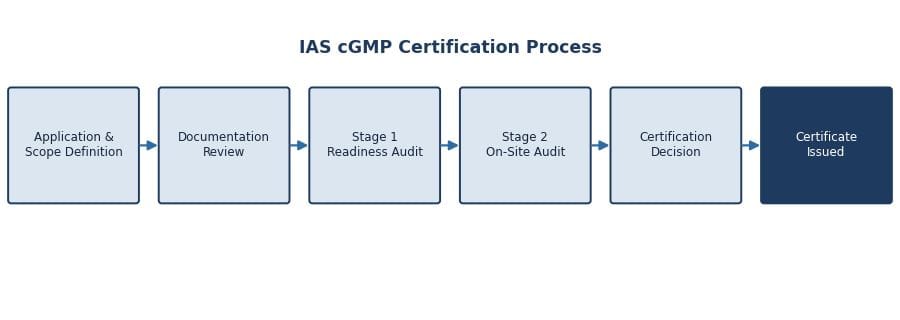
IAS runs certification as a structured, staged process. The exact document set and audit focus depend on the applicable scheme and product category, but the journey follows the same shape for every applicant. The general certification process and the audit procedure are set out on their own pages.
- Application and scope confirmation — product category, sites and the applicable GMP or cGMP scheme are identified.
- Documentation review — quality manual, SOPs, change control, CAPA, validation and batch or production records, and data integrity controls, as applicable.
- On-site certification audit — an IAS auditor assesses the facility against the areas relevant to the confirmed scope.
- Corrective action, where findings arise — nonconformities are addressed before the certification decision is finalised.
- Certification decision and certificate issuance — the certificate states the scheme and scope it was assessed against.
Manufacturers wanting a head start often complete GMP training in Australia before the on-site audit. The practical reasons applications stall are set out in what delays a cGMP certification.
Areas an Auditor Typically Looks At
Framed against the applicable scheme and product category, never as a universal checklist:
- Facility layout, cleanliness and environmental controls, as applicable to the product category
- Process controls and validation records, where validation applies to the scheme
- Batch or production record-keeping and traceability, as applicable
- Change control and corrective and preventive action systems, as applicable
- Data integrity practices relevant to the applicable scheme
- Staff training and competency records
- Supplier and incoming material controls, where relevant to the product category
None of these areas is assessed in isolation, and none applies identically across every scheme. A food facility’s traceability expectations differ from a pharmaceutical facility’s batch record expectations.
See where your product line fits? A scoping conversation carries no obligation and ends with a written quotation.
Certification Lifecycle: Staying Conformant After Day One
A cGMP certificate is not a one-off event. IAS certification runs on a lifecycle of ongoing conformance rather than a single audit and a permanent document.
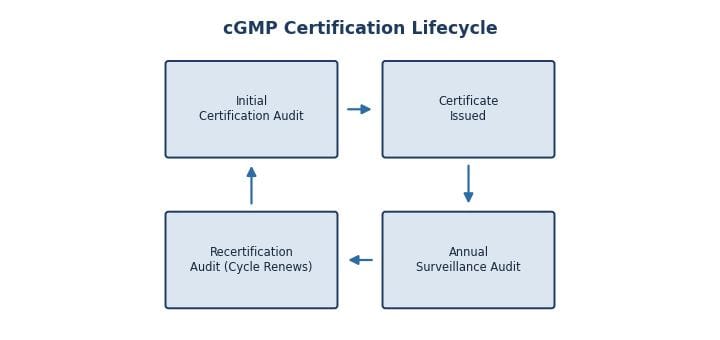
- Validity confirmed at the certification decision — rather than a fixed period quoted upfront, IAS confirms certificate validity and the surveillance schedule as part of the decision, reconfirmed at each surveillance visit.
- Readiness shapes the pace — facilities that keep quality systems current and address findings promptly move through surveillance and recertification with the least disruption.
- Change invites scrutiny — significant process changes, new product lines or site relocations should expect closer attention at the next scheduled visit.
cGMP Certification Cost in Australia: What Shapes Cost and Timeline
IAS does not publish fixed prices or fixed week-by-week timelines, because both depend heavily on facility-specific factors. Every applicant receives a fixed written quotation once scope is confirmed, so there are no surprise costs mid-process.
| Driver | Why it matters |
|---|---|
| Number and location of sites | Multiple sites across Australian states, or a site plus an offshore contract manufacturer, extend audit scope and travel. |
| Product families and scheme complexity | A single product line against one scheme is more straightforward than multiple categories against different frameworks. |
| Facility readiness | Existing, well-maintained SOPs, validation records and CAPA history reduce documentation review and corrective-action effort. |
| Existing regulatory licensing | A current TGA licence or established FSANZ-aligned food safety program typically means more underlying documentation is already in place. |
| Surveillance and recertification cadence | Ongoing surveillance audits are scoped and quoted separately from the initial certification audit. |
Want a real number rather than a range? Send your sites and product categories and IAS will quote in writing.
Why Australian Manufacturers Choose IAS
- UQAS accreditation — the basis for independent, third-party assessment by IAS. Full detail is set out on the accreditation page.
- Precise scoping — certification scoped exactly to the applicable scheme and product category, which avoids overclaiming on the certificate.
- One point of contact — through application, audit and ongoing surveillance, rather than a process handed between departments.
Many Australian manufacturers pair cGMP certification with related management system certification such as ISO 9001 certification for quality management, and ISO 22000 certification or HACCP certification for food safety, to present a coherent quality and safety story to export customers. Background on how the wider programme fits together is in this guide to ISO certification in Australia.
An IAS cGMP certificate is never presented as TGA approval, registration or clearance, and never as a replacement for a TGA manufacturing licence, an FSANZ-aligned food safety obligation, or any other statutory licence. Certification is a voluntary, complementary layer of independent assurance that sits alongside — not instead of — a manufacturer’s regulatory obligations.
Quick Definitions
- GMP: Good Manufacturing Practice — the general discipline of controlled, documented, repeatable manufacturing.
- cGMP: Current Good Manufacturing Practice — the same discipline, with systems kept current with evolving regulatory expectations and technology.
- Scheme and scope: the framework and the product range the audit measures you against, settled at application.
- Surveillance audit: a periodic check confirming the certified system remains conformant and that prior findings have been addressed.
- Recertification: the reassessment that renews the certification cycle.
The Next Step: Talk to IAS About Certification in Australia
If your facility is ready to move from domestic regulatory compliance to independent, export-ready cGMP certification, IAS can confirm the applicable scheme, the scope and a fixed written quotation for your specific product category. There is no obligation to proceed after scoping, and cGMP certification can be combined with ISO 9001, ISO 22000 or HACCP under one coordinated programme where that is useful.
Further common questions are answered on the site-wide certification FAQ page, and IAS’s handling of enquiry data is set out in the online privacy statement.
Frequently Asked Questions
Do Australian manufacturers have to hold cGMP certification by law?
No. Statutory obligations such as a TGA manufacturing licence for therapeutic goods, or FSANZ-aligned food safety compliance, are the legal requirements. cGMP certification in Australia from IAS is voluntary and complementary. Many manufacturers add it for export credibility and buyer assurance.
We already hold a TGA manufacturing licence — why also seek cGMP certification?
A TGA licence satisfies Australian domestic law, but it is not always the document overseas distributors or retailers recognise or request. Independent cGMP certification gives export partners a portable, third-party statement of conformity alongside your existing licence. It is not TGA approval, registration or clearance, and it never replaces the licence itself.
How does cGMP certification relate to FSANZ food safety requirements for exporters?
FSANZ sets Australia’s food standards, enforced by state and territory food authorities, and neither issues a GMP certificate. Food exporters typically maintain FSANZ-aligned compliance and HACCP as their regulatory baseline, then add cGMP certification as an additional, buyer-facing layer of assurance.
Can nutraceutical and complementary medicine manufacturers be certified under cGMP?
Yes. Nutraceuticals and complementary medicines are among the sectors most commonly certified, particularly for manufacturers exporting into Asian markets where GMP certificate documentation is frequently requested by distributors.
Our facility manufactures several product lines — how is scope decided?
Scope is agreed during the application stage, based on the product categories, sites and applicable GMP or cGMP scheme relevant to each line. The certificate therefore reflects what was actually assessed rather than the facility as a whole.
How can an overseas buyer verify that our IAS certificate is genuine?
Buyers and partners can verify an IAS-issued certificate through the IAS certification search, which confirms the certificate’s status, scope and validity directly against IAS records rather than relying on a printed copy.